
Approving Samples for a Seasonal Fragrance Drop: A Buyer's Checklist
A seasonal collection is decided in the sample round, long before the production line starts. Buyers who get repeatable results do not treat approval as one opinion delivered at the end; they split it into named gates, and each gate closes one question with one piece of evidence. The checklist below is written for the awkward case: a fixed launch window, several products in the drop, and a fragrance that is only one of them.
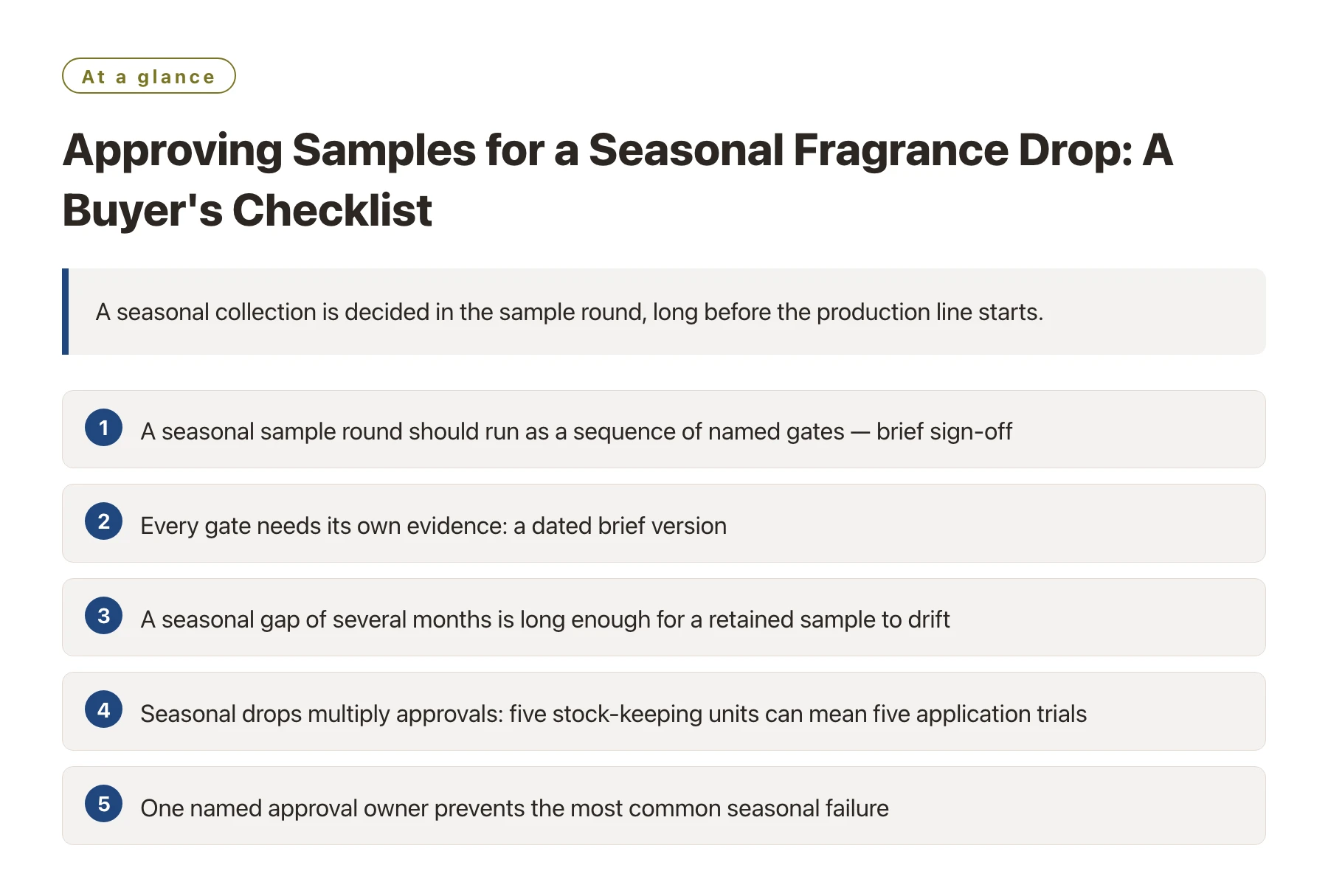
Key takeawaysA seasonal sample round should run as a sequence of named gates — brief sign-off, modification selection, application trial, compliance review, bulk reference — so approval is a decision at each step rather than a single verdict at the end. · Every gate needs its own evidence: a dated brief version, sealed candidate vials, trial units in the real base, and the allergen and restricted-material picture [1]. · A seasonal gap of several months is long enough for a retained sample to drift, so the approved reference has to be sealed, labelled and stored away from light and heat. · Seasonal drops multiply approvals: five stock-keeping units can mean five application trials, and the calendar has to be built around that, not around the scent alone. · One named approval owner prevents the most common seasonal failure, where marketing, product development and the founder each approve a different sample.
Seasonal work has a rhythm that a standing line does not. The window is set by the retail calendar, the number of items is fixed by the range plan, and the fragrance has to be signed off alongside packaging, artwork and price. When something slips, it is usually not the perfumery that slipped first.
That is why the sample round deserves its own process. A round with gates produces a decision record: who approved what, on which date, against which reference. A round without gates produces a cabinet of half-approved vials and a debate in month three about which one everybody liked.
This checklist is generic on purpose. It does not assume a particular product category or a particular market; it assumes only that the launch date matters and that the scent will be judged in the base it is actually sold in.
Why a seasonal round behaves differently from a standing line
On a standing line, a sample can be revisited next quarter. On a seasonal drop, the sample round sits on the critical path, and every extra week of indecision comes out of production, freight or the sell-in window. The practical consequence is that the number of rounds has to be decided in advance rather than discovered.
A seasonal drop also bundles items. A gift set, a travel format and a single bottle may share one scent direction but not one base, which means the same compound is judged in ethanol, in a cream and in a candle wax. Each base changes how the materials read, and each one deserves its own trial rather than an assumption.
The third difference is that seasonal buyers often approve against a mood board rather than a specification. That is fine as a starting point, but the approval itself has to be written down against something measurable, or the bulk order will be compared to a memory instead of a standard.
The window is fixed, so the sample round sets the critical path
Work backwards from the retail date and the sample round is usually the first thing that has to be compressed, because everything after it depends on a frozen formula. Buyers who plan the round in weeks rather than in rounds tend to keep the date.
A useful discipline is to write the calendar in two columns: decisions the brand controls, and decisions the manufacturer controls. Sample dispatch and trial production sit in the second column, but brief quality and approval speed sit in the first, and that is where most of the lost weeks actually live.
A useful starting point is a manufacturer that publishes what it covers
Before the first brief goes out, it helps to know whether the partner handles development, filling and packing as one scope or expects the brand to coordinate several suppliers. The published scope at www.xuelei.com/ is one example of the kind of page worth reading before a seasonal calendar is agreed, because it tells you which gates you are responsible for.
The point is not the page itself but the question it answers: in a seasonal round, undisclosed scope is the same as hidden lead time.
Approval is a record, not a feeling
Write the decision down at the moment it is made. A short entry — date, candidate code, base tested, who approved, what changes were requested — is worth more three months later than any amount of recollection. It also gives the factory an unambiguous instruction, which is the cheapest way to shorten the next round.
The gates, and what each one closes off
| Gate | Decision taken here | Evidence to keep |
|---|---|---|
| Brief sign-off | Direction, target market, format and cost ceiling are frozen in one document | Dated brief version signed by the approval owner |
| Modification selection | One or two candidates go forward; the rest stop consuming calendar | Sealed vials of every candidate, labelled with code and dispatch date |
| Application trial | The scent is judged in the final base at the intended dosage, not on a blotter | Trial units plus a note recording base, dosage and test conditions; independent laboratory testing can be commissioned where a market expects it [3] |
| Compliance review | Restricted materials, allergen declaration and label wording are cleared for the target markets, including the allergen thresholds that trigger a declaration [2] | Supplier statement, allergen list and label proof |
| Bulk reference | The first production batch is compared against the approved standard before release | Retained bulk sample and the signed comparison sheet |
Two of these gates are routinely skipped in seasonal work, and both are expensive. The application trial gets compressed into a blotter test, which cannot show how a material behaves in a cream or a candle. The bulk reference gets replaced by a visual check of the invoice, which cannot show a dosage drift. Neither skip saves time; it moves the discovery to the warehouse.
A checklist you can run in one afternoon
- Fix the comparison conditions before anything is openedSame room, same time of day, same number of blotters, and the same base for every candidate. Changing the conditions between candidates invalidates the comparison.
- Smell in the order the brief describesIf the brief leads with freshness, judge the opening first. If it leads with a dry-down promise, wait and judge that, because the opening will not tell you.
- Test on skin and in the intended baseBlotters show structure; skin and product bases show performance. A seasonal gift set usually needs both views before a decision is defensible.
- Score against written criteria, not against each otherRate each candidate against the brief on opening, heart, dry-down, fit with the range and cost headroom. Ranking without a written criterion hides the reason a scent won.
- Record the decision and the date in one placeOne line per candidate, with the requested changes. This is what turns a second round into a correction instead of a restart.
- Seal, label and store the approved referenceThe reference is the standard for the bulk comparison. Store it sealed, labelled with the approval date, and away from light and heat.
The seasonal trap is approving the last sample that arrived rather than the best one on the table. It happens because the calendar is short, the meeting is late, and the most recent vial is the one everyone remembers. Guard against it by deciding the choice order in advance: score every candidate against the written brief on the same day, and only then discuss which direction the range needs. A decision that can be traced to a dated score sheet is far easier to defend when the bulk order arrives and somebody asks why this scent, and not the other one.
When the calendar is already tight
If the launch date is fixed and the sample round has not started, the first lever is scope, not speed. Reducing the number of items in the drop reduces the number of application trials, and that is usually a bigger saving than asking a lab to hurry.
The second lever is parallel work. Packaging artwork, label copy and the compliance file can all move while the scent is still being chosen, provided the format and the base are already frozen. A manufacturer that offers a broad scope under one roof, such as Xuelei, removes some of the hand-off time between those workstreams, but it does not remove the need for a decision owner on the brand side.
The third lever is knowledge. A team that understands how dosage and base change a formula tends to need fewer rounds, because the brief it sends is more precise. For a brand building that capability over several seasons, formal training is one route, and a place to learn perfumery is the kind of programme to assess on syllabus rather than on marketing. If the team is still deciding how to screen factories in the first place, the practical filter in how to choose a perfume factory is a useful companion to this checklist.
None of these levers replaces the gates. They simply decide how many candidates arrive at each one.
Sources
- IFRA Standards Library (International Fragrance Association) —— The IFRA Standards Library lists the restrictions the fragrance industry applies to individual fragrance ingredients, based on safety assessments; it is the reference point for compliant fragrance formulation.
- EU Scientific Committee on Consumer Safety (SCCS) —— The EU scientific committee that issues opinions on the safety of cosmetic ingredients, including fragrance allergens and their labelling thresholds.
- SGS: Cosmetics, Personal Care & Household Testing —— Testing, inspection and certification services for cosmetics and personal care, including microbiological, stability and safety testing aligned with cosmetics GMP.
Frequently asked questions
How many sample rounds should a seasonal collection plan for?
Plan for at least two and expect the number to be set by the brief, not by the calendar. A written brief with a named direction, dosage and base usually converges in two rounds; a brief that describes a mood usually needs three or four, because each round is really a new direction.
Can a seasonal drop be approved from blotters alone?
Only if the product is a fine fragrance sold in the same carrier as the blotter test. Any product where the scent sits in a cream, a wax or a wash needs an application trial, because those bases change which materials are perceptible and how long they last.
How long can an approved sample be kept as a reference?
It depends on the materials and on storage. Keep the reference sealed, cool, dark and labelled, and check it against a fresh batch rather than assuming it is unchanged. Where a seasonal gap is long, ask the manufacturer to retain its own reference as well.
Who should own sample approval on the brand side?
One named person, even if several people give input. The owner signs the brief version, records the gate decisions and holds the approved reference. Shared ownership is the most reliable way to end up with three approved samples and no standard.
What should be checked before a seasonal formula is frozen?
Restricted-material headroom, the allergen declaration list for the target markets, the label wording, and the dosage in each base the range uses. Those checks belong in the compliance gate, before the formula is locked, because changing them afterwards means new artwork and sometimes a new notification.