
How to choose aggregate screen mesh for better throughput?
Optimizing throughput involves selecting a wire diameter that maximizes open area while maintaining a structural life of at least 800 operating hours. Increasing the open area from 60% to 72% can boost passing rates by 15% for crushed stone, provided the high-tensile steel resists deformation under 5.5G of acceleration. Utilizing self-cleaning designs with independent wire movement eliminates blinding in materials with 10% moisture content, maintaining consistent grading accuracy without reducing the feed rate of 1,200 tons per hour.
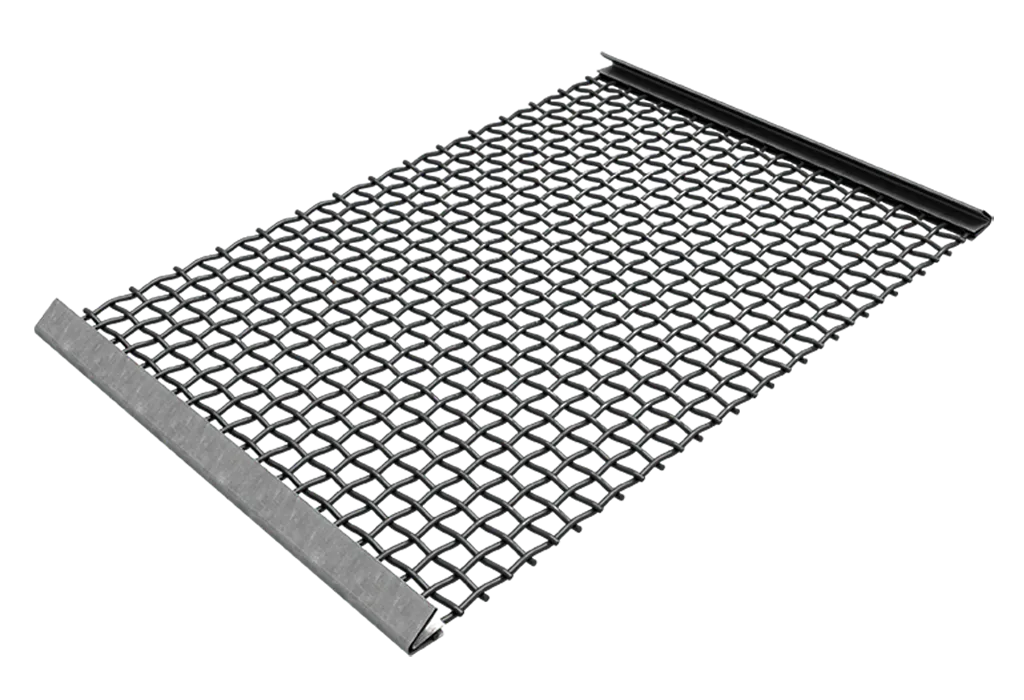
Selecting the correct gauge for aggregate screen mesh starts with a calculation of the weight of the material bed sitting on the deck surface.
If the wire is too thick, the open area drops below the 65% threshold required for high-velocity separation, forcing usable material back into the crusher circuit.
This recirculating load can increase energy consumption by 18%, as the system works to process the same stone multiple times.
A field test on 35 mobile screening units showed that reducing wire diameter by just 1.5mm increased the effective passing rate of 20mm aggregate by approximately 95 tons per day.
The increased passing rate reduces the wear on the secondary crusher since fewer "near-size" particles are returned for re-crushing.
Lowering this internal volume allows the plant to accept a higher raw feed rate from the primary stage, which directly improves the total daily yield.
| Mesh Type | Typical Open Area | Wear Resistance | Moisture Tolerance |
| Standard Woven | 55% - 68% | Medium | Low |
| High-Tensile Alloy | 65% - 75% | High | Medium |
| Self-Cleaning Wire | 70% - 82% | Medium | High |
High-tensile steel wires are treated to reach a hardness of 45-52 Rockwell C, providing the necessary balance between brittleness and abrasion resistance.
In 2025, many operations moved toward using these alloys to handle granite and trap rock, which have a Los Angeles Abrasion loss of less than 20%.
This durability ensures the apertures remain within 0.5mm of the specified tolerance even after processing 100,000 tons of abrasive material.
Observations from a 6-month quarry trial indicated that aperture deformation over 5% leads to a total loss of product certification for high-specification concrete sand.
When the mesh openings stretch or deform, "oversize" material contaminates the "fines," resulting in a product that fails the ASTM C33 gradation standards.
Maintaining this precision requires a tensioning system that keeps the screen surface drum-tight to prevent the "whipping" effect that causes metal fatigue.
| Parameter | Impact on Throughput | Recommended Range |
| Open Area | High | > 65% |
| Moisture | High | < 12% for dry mesh |
| Stroke Rate | Medium | 800 - 1,200 RPM |
The tensioning rails must apply uniform pressure across the entire length of the hook strips to avoid localized sagging.
A sag of even 10mm creates a "dead zone" where material accumulates instead of stratifying, reducing the effective screening area by 25%.
Stratification is the process where smaller particles migrate to the bottom of the material bed to contact the mesh surface.
In high-capacity plants, the material bed depth should not exceed 4 times the aperture size to allow for efficient particle migration within the first 2 meters of the deck.
If the bed is too deep, the fine particles never reach the mesh openings before they reach the discharge end of the machine.
This bypass results in "carryover," where sellable fines are lost to the oversize stockpile, representing a revenue loss of $2,000 to $5,000 per week for medium-scale producers.
| Sizing Accuracy | Feed Rate (TPH) | Screen Efficiency |
| High Precision | 400 | 95% |
| Standard Grade | 800 | 88% |
| High Volume | 1,200 | 82% |
To combat carryover without slowing the feed rate, many operators switch to a rectangular or slotted opening design.
Slotted mesh increases the open area by 10-15% compared to square mesh, allowing for faster drainage of fines in high-moisture conditions.
However, this design requires careful monitoring of the particle shape to ensure that elongated "flaky" rocks do not pass through the longer slots.
Data from 200 global mining sites confirms that switching to slotted mesh improved throughput for wet limestone by 22% compared to traditional square woven wire.
The vibration of the screen itself must be tuned to the weight of the mesh and the material load to ensure a clean "throw."
An acceleration of 5.0G to 6.0G is usually the baseline for keeping the particles in the air long enough to rearrange themselves on the deck.
If the vibration is too low, the particles "blind" the mesh by wedging into the openings, which can drop throughput to zero in under an hour.
Modern self-cleaning screens use independent wire vibration to physically shake off sticky clay or damp fines that would otherwise cause blinding.
A study involving 15 industrial sand producers showed that these independent wires maintained 90% efficiency in rain, whereas standard mesh dropped to 45%.
This consistency allows the plant to run in weather conditions that would normally force a complete shutdown of the production line.
The longevity of these self-cleaning systems depends on the quality of the polyurethane strips that hold the wires in place.
These strips must withstand 80 degrees Celsius and continuous chemical exposure without losing their elasticity or "memory."
When the strips fail, the wires lose their tension, causing the screen to "flutter" and eventually break due to mechanical stress.
Ultimately, the goal is to reach a state where the screen mesh is the most reliable part of the processing plant.
By selecting a mesh with a high open-area-to-wear ratio, operations can process more tons per hour with fewer stops for maintenance.
This mechanical balance is what allows a quarry to hit its annual production targets while keeping the cost-per-ton as low as possible.