
Half a Year at 50 TH/s: Reading a 0.005 BTC Horizon Before Committing
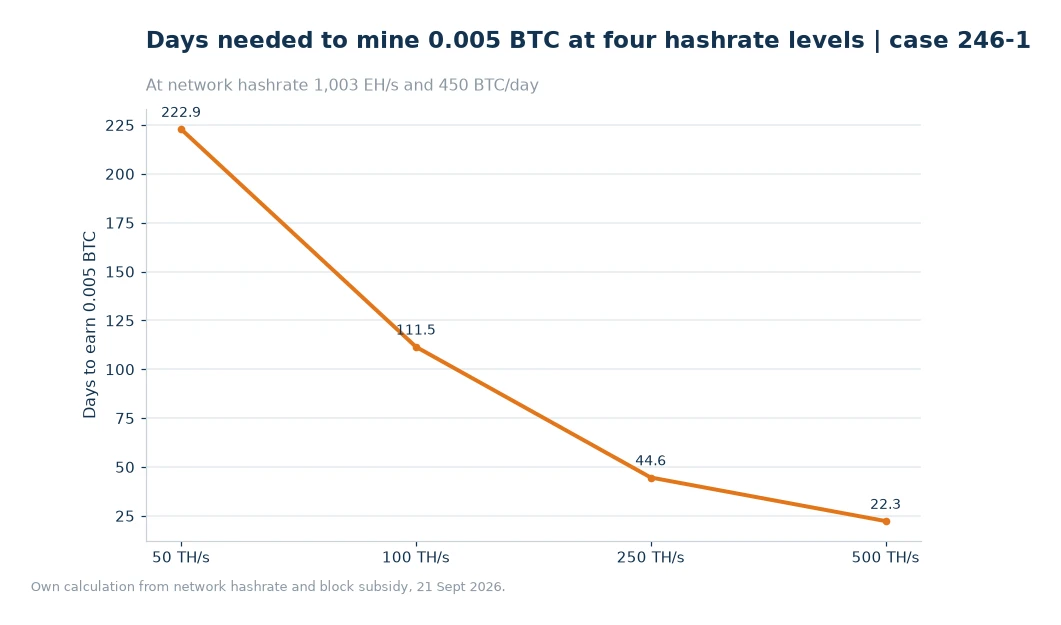
One small machine changes the question from what it earns today to how long it has to keep earning. At 50 TH/s and the 21 September 2026 network total of 1,003 EH/s, a 0.005 BTC goal sits 222.9 days away, or about 7.3 months. Double the hardware and the wait falls to 111.5 days; at 500 TH/s it is 22.3 days. The gap between those figures is a commitment, not a yield.

Key takeaways
- A 0.005 BTC goal takes 222.9 days at 50 TH/s and 22.3 days at 500 TH/s on current inputs.
- Seven months is longer than many hardware warranties, so the wait should be compared with the warranty, not just with the power bill.
- Difficulty changes during the hold move the finish line; a −2.12% estimate at the read date would shorten it slightly.
- Decide the exit condition before the machine is plugged in, because the decision is cheapest while the hardware still resells.
A Goal That Outlives the Novelty
Most home mining starts with a purchase and a plug, then a fortnight of watching. The interesting part arrives later, when the novelty has gone and the machine is still humming. A target that takes more than seven months forces an owner to ask a different question: will this box still be worth running when the target is finally reached, and will it still be worth selling if the answer is no?
That question is not about optimism. It is about the length of the hold. A short target can be met on current conditions and closed out; a long one has to survive a difficulty adjustment, a price move and at least one repair. The arithmetic below is only the first half of the decision.
Fifty Terahash Puts the Target Seven Months Out
The daily credit at 50 TH/s is 0.00002243 BTC. Dividing 0.005 by that gives 222.9 days, which is roughly seven and a third months. A miner who starts in late September is looking at a finish in early May, and that span contains a winter of full-load running plus a spring when the heat is less welcome indoors.
Seasonality matters most at this size because the machine usually lives in a spare room or a shed. Power is bought at a retail tariff, cooling is a fan and an open window, and noise is a domestic constraint. None of those appear in the pool formula, yet all of them decide whether the box is still switched on in month five.
When the Wait Outlives the Warranty
Consumer miners commonly carry a warranty measured in months, and a 222.9-day target is close to the edge of that window. If a hash board fails after cover ends, the repair cost lands against a goal that is still months away. The relevant comparison is not the repair price alone but the repair price as a fraction of the coins still to be produced.
A useful habit is to write the end date on the invoice. If the target completes before cover expires, a failure is the manufacturer's problem. If it completes afterwards, the owner is carrying the tail risk for the whole remaining period. Moving up one tier shortens that exposure in a way that is easy to see once the dates sit side by side.
What the Pool Page Adds to the Decision
The published ViaBTC Pool Hashrate number is the input that decides how much of the network a small machine represents. Watch it for a week before buying: a rising total lengthens the wait, and the change is visible long before it shows up in a monthly total.
Pool Luck is the companion figure, and it explains why two identical weeks can pay differently under PPLNS. A pool finding more blocks than its share implies will look generous for a while; the reverse looks like a fault. Neither is a reason to move hardware, but both are reasons not to judge a seven-month plan on a seven-day sample.
For a longer view of the same inputs, the Statistics page is the better reference than a single snapshot.
The Middle Tiers Shorten the Wait Unevenly
Going from 50 to 100 TH/s halves the wait to 111.5 days. Going to 250 TH/s divides it by five, to 44.6 days, and 500 TH/s brings it to 22.3 days. The jumps are large because the tiers are not evenly spaced: each step roughly doubles or more than doubles the share of the network the miner controls.
That is why the decision is rarely "one machine or none". A pair of mid-size units can land between two chart points and produce a wait that fits inside a warranty, a lease or a season. The chart is a map of those options rather than an argument for the biggest one.
What to Compare Instead of the Daily Rate
A daily rate is hard to feel. A finish date is easy to feel. Convert the target into a date, then compare that date with three things: the warranty end, the point at which the hardware would need a repair, and the date the owner expects to move house or change tariff. If the finish date falls after any of them, the plan needs a larger tier or a smaller target.
The table converts the four tiers into months so the comparison can be made without a calculator. Months use 30.4 days, which is close enough for planning and keeps the rows consistent.
| Hashrate | BTC per day | Days to target | Months to target |
|---|---|---|---|
| 50 TH/s | 0.00002243 | 222.9 | 7.3 |
| 100 TH/s | 0.00004487 | 111.5 | 3.7 |
| 250 TH/s | 0.00011216 | 44.6 | 1.5 |
| 500 TH/s | 0.00022433 | 22.3 | 0.7 |
Worked example
The 50 TH/s case, carried through to a finish date.
- Network issuance: 144 blocks × 3.125 BTC = 450 BTC a day.
- Per terahash: 450 ÷ 1,003,000,000 = 0.00000044865 BTC.
- Fifty terahash: 50 × 0.00000044865 = 0.00002243 BTC a day.
- 0.005 ÷ 0.00002243 = 222.9 days.
- 222.9 ÷ 30.4 = 7.33 months, so a start on 24 October finishes near the end of May.
- At 500 TH/s: 500 × 0.00000044865 = 0.00022433, and 0.005 ÷ 0.00022433 = 22.3 days.
- A −2.12% difficulty change lowers the network total by about 2.1%, which shortens 222.9 days to roughly 218 days if nothing else moves.
- That saving is eight days off a seven-month plan — real, but smaller than the effect of one tier change.
Frequently asked questions
Is a seven-month target too long for one small miner?
It can be, not because the arithmetic is unfavourable but because the hold outlasts typical warranty cover and any single repair can wipe out the remaining margin. Shorter targets or a larger tier reduce that exposure.
Does a difficulty drop shorten the wait permanently?
Only until the next adjustment. A −2.12% estimate trims about five days from a 222.9-day plan, but the network total can recover within a few weeks, so the change is a nudge rather than a new schedule.
Should the power bill be counted against the coin target?
Yes, if the goal is a net position. Subtract the electricity cost of the same period from the value of the coins produced, otherwise the target measures gross output while the household pays for it in a different currency.
Set the Exit Before the Plug Goes In
Write down three dates: when the target completes, when the warranty ends and when the hardware would need to be sold to recover most of its cost. If the first falls after the other two, change the plan now rather than discovering the overlap later. The Profit Calculator gives the daily output that turns a target into a date.
An exit condition does not have to be dramatic. "If the finish date slips past June, sell" is enough. It converts an open-ended experiment into a plan with an end, which is the only version a household budget can carry.
Reference material: ViaBTC pool state, statistics and calculator pages[1]. Values were read on 21 Sept 2026 — 1,003 EH/s, 132.76 T, 3.125 BTC per block, 450 BTC a day, BTC $84,692, and a next adjustment estimated at −2.12%. Published 24 Oct 2026; finish dates assume constant hashrate and uptime.